
Plant protein can build as much muscle as meat, provided a factory has been at it first.
The two trials the plant side leans on hardest both found vegans growing muscle at the same rate as meat-eaters, and both repay reading all the way down to the menu. In São Paulo, nearly half the vegans’ daily protein came out of a tub of soy isolate. In Exeter, the vegan diet was built around mycoprotein, a mould grown on glucose in industrial fermenters, in a study paid for by the company that makes Quorn.
Whole plants can reach the same number of grams as a steak. They make you eat far more food or far more calories to get there, usually both, with a heavy load of carbohydrate attached, and less of the protein that finally arrives is fit for building muscle. Strip out the fibre and the chemistry a seed uses to protect itself, and the gap closes. Which tells you exactly where the gap was.
Why 20g of plant protein does less than 20g of animal protein
Two tubs can both promise 25g a scoop and deliver very different amounts of what muscle actually uses. The difference comes down to how much survives digestion, whether the scarcest amino acid holds out, and how loudly the leucine signal rings.
The figure on the label knows none of that. In Britain and the EU, the law defines the protein on a food label as the food’s nitrogen content multiplied by 6.25. It’s an estimate built on the assumption that all the nitrogen belongs to protein, and plants stretch it. When a New Zealand lab measured the amino acids actually present in cooked peas, cooked kidney beans and roasted peanuts, they added up to only about 80% of the protein on paper.
Less of it survives the gut
Protein counts once it has been broken down and absorbed in the small intestine. Whatever reaches the large bowel intact goes to bacteria, and the FAO scores it as lost. In 2013 the FAO recommended a measure built on exactly that point, the digestible indispensable amino acid score, or DIAAS. It measures each essential amino acid at the end of the small intestine and marks the food on whichever one comes up shortest. A score of 100 covers human requirements gram for gram.
Beef, pork and dairy have all scored around 100 or higher in growing pigs, the standard animal for the test, and hard-boiled eggs came in at 113. Cooked beans, peas and chickpeas land anywhere from about 60 to the low 90s depending on the bean and the lab. Oats scored 54 and wheat sits in the 40s. Roasted peanuts, the raw material of peanut butter, scored 43.
The shortfall is deliberate, on the plant’s part. A seed is an embryo with a packed lunch, and the plant has gone to some trouble to stop you eating the lunch. Fibre walls the protein in, trypsin inhibitors block one of the main enzymes that cut protein apart, and tannins latch onto protein and carry it through undigested. Those compounds keep a rap sheet of their own, and a poor digestion score is one charge among many in the case against plants.
The food industry worked out the fix decades ago, and it consists of removing as much plant as possible. In that same New Zealand study, same lab and same method, cooked peas scored about 60. Pea protein, extracted from the pea and dried to a powder, scored 82. Soy protein isolate scored 90. Whey protein isolate scored 109 and milk protein concentrate 118. Take away the fibre and most of the seed’s defences and the pea’s score jumps by more than 20 points.
What a factory can’t do is add an amino acid the plant never made. Rice protein concentrate scored 37 in the same trial, because rice is short of lysine and no centrifuge on earth puts it back.
The scarcest amino acid sets the limit
Muscle is built to a fixed recipe. A car plant with 400 wheels and 60 engines builds 60 cars, and 160 wheels go in the skip. Muscle cells work the same way: they build until the scarcest essential amino acid runs out, and whatever is left over has its nitrogen stripped off and gets burned for fuel. Tracer studies comparing soy and milk protein have found more of the soy’s amino acids burned or held back by the gut and liver, and less left for muscle.
The scarce part in plants is predictable. Grains run short of lysine and beans run short of methionine. When researchers in Maastricht analysed commercial protein powders, the plant ones averaged 3.6% lysine and 1.0% methionine. The animal ones averaged 7.0% and 2.5%. Human skeletal muscle, the thing a lifter is trying to build more of, is 7.8% lysine. Half the lysine means ordering twice the delivery, and the surplus goes in the skip with the wheels.
The leucine signal arrives quieter
A muscle grows when the cell is told to build, and leucine carries the order. It is sensed inside the muscle fibre, where it activates a protein complex called mTORC1 that sets protein synthesis running, and the response tracks how sharply leucine rises in the blood after a meal. The benchmark dose in the labs is 25g of whey, which delivers about 2.7g of leucine and reliably gets young muscle going.
Head to head, the gap shows up on schedule. At McMaster in 2009, drinks matched gram for gram on essential amino acids produced 31% more muscle protein synthesis from whey than from soy isolate after a leg session in young men. In 2007 the same lab split 56 novice lifters between skimmed milk, a soy drink matched for protein and calories, and a carbohydrate drink after every session for 12 weeks, and the milk group gained more lean mass and more growth in their fast-twitch fibres.
Age makes it worse. In Maastricht, 35g of wheat protein did less for men averaging 71 than 35g of casein, and it took 60g of wheat protein, a dose picked to match the leucine in the whey, before the muscle response rose substantially. The same group has since found 30g of wheat protein matching 30g of milk protein in young men, which is cheerful news for anyone who is 24 and drinks wheat protein from a shaker. Older muscle needs a louder signal before it responds fully, and the lifter over 55 is exactly where a quieter one costs the most.
What 40g of plant protein costs to eat
Every plant gram is bought with food. Each line is roughly 40g of protein, the amount in one modest steak, from USDA figures:
- Sirloin with its fat on: 200g raw. 400 calories, no carbohydrate, no fibre.
- Lentils: 445g cooked. 515 calories, 90g carbohydrate, 35g fibre.
- Black beans with white rice: 680g cooked. 890 calories, 176g carbohydrate, 32g fibre.
- Peanut butter: 180g. Over 1,000 calories, about three-quarters of them fat.
- Quinoa: 910g cooked. 1,090 calories, 194g carbohydrate, 25g fibre.
- Raw broccoli: 1.42kg. 480 calories, 94g carbohydrate, 37g fibre.
The steak is the smallest plate on the list and the only one that doesn’t arrive with a sack of carbohydrate. The thriftiest plant option, lentils, still means more than twice the weight of food and 90g of carbohydrate a sitting. Make it four meals a day and it’s 1.8kg of cooked lentils, 358g of carbohydrate and around 140g of fibre, every day, for as long as you want to keep the muscle. How much protein a lifter needs in the first place is its own argument.
Every plant line on that list is also flattered, because it counts the plant’s grams as though they were the steak’s. Score them for quality and the plates grow again. Roasted peanuts score 43, so to deliver what the steak’s protein does, the peanut butter plate has to more than double, to somewhere north of 2,000 calories, to match a 400-calorie sirloin.
The broccoli that beats a steak
The per-calorie comeback goes back at least to Joel Fuhrman’s Eat to Live, and the version doing the rounds online credits 100 calories of broccoli with 11.1g of protein and 100 calories of steak with 6.4g. USDA figures put raw broccoli at 8.3g per 100 calories. Top sirloin with its fat left on comes in around 10g, and trimmed lean it reaches nearly 17g. The claim only works against a very fatty cut. Tasting Table printed it and later added a correction to the top of the article calling it incorrect.
Grant them the fattiest steak anyway, because the arithmetic was never the problem. A per-calorie measure flatters anything that is mostly water, and raw broccoli is about 89% water. Matching one sirloin’s protein takes 1.42kg of it, eaten in one sitting, by a person, on purpose.
Chasing the leanest meat to win the per-calorie game backfires as well. Protein without fat has a ceiling of its own, and the fat on that sirloin is part of what makes it a meal.
The vegan muscle trials, read down to the menu

Both headline trials found what they say they found, and both fed their vegans something no field has ever grown.
São Paulo, 2021
At the University of São Paulo, 19 young men who had been vegan for at least a year and 19 omnivores, none of whom had lifted weights in the previous year, trained their legs twice a week for 12 weeks. Both groups were brought up to 1.6g of protein per kilo of bodyweight, and both grew muscle at the same rate.
Left to their own cooking, the vegans had been eating 65g of protein a day, 0.91g per kilo. The trial closed the gap with an average of 58g a day of Supro, a soy protein isolate from DuPont’s soy business Solae, so nearly half the vegans’ daily protein came out of a tub. The meat-eaters were topped up as well, with whey. Their carbohydrate ran at around 350g a day against the omnivores’ 216 to 272g, and they ate more than twice the fibre.
At identical protein grams, the vegans still took in about a fifth fewer essential amino acids, less leucine and over a third less lysine. The labels matched. The contents didn’t.
The authors flagged all of this themselves. They noted that the soy isolate was free of the factors that block protein absorption in whole plants, and that reaching 1.6g per kilo from mostly whole foods would mean eating a lot more food, more calories and more of those blocking compounds. Their result, in their own words, is “confined to a vegan diet with a relatively large supplemental plant protein isolate intake.”
New To Carnivore?
Get my Carnivore Guide, free.
On the leg press, the meat-eaters added 117kg and the vegans 97kg, a 20kg gap in 12 weeks that the statistics were entitled to call a draw, and did.
Exeter, 2023
At the University of Exeter, 22 young men and women trained 5 days a week for 10 weeks on 2g or more of protein per kilo, one group omnivorous and one vegan. Lean mass rose by 2.6kg on the omnivore side and 3.1kg on the vegan side, a difference that meant nothing statistically.
The vegan diet was built around mycoprotein, supplied as Quorn products plus a 105g daily mycoprotein drink. The omnivores got a milk protein drink instead, matched for protein. Mycoprotein is a fungus, Fusarium venenatum, and fungi have a kingdom of their own, well away from plants. It was first found in a soil sample in 1967. It is grown on glucose in fermenters and heat-treated afterwards to break down the RNA that would otherwise send the eater’s uric acid climbing. Quorn reached the shops in 1985, made in a fermenter ICI had going spare after an animal-feed protein venture folded. The trial was funded by Marlow Foods, which makes Quorn, and one of the authors was a Marlow Foods employee.
The vegan group ate 75g of fibre a day to the omnivores’ 27g. Everyone took creatine, added to head off what the authors described as the most obvious deficiency, for training purposes, that a vegan diet can cause. Eight of the 10 on the vegan side were habitual omnivores assigned to it for the 10 weeks, and the researchers noted from their counselling sessions that the vegan group found its protein targets harder to hit.
The powders
The rest of the plant side’s evidence runs to the same pattern. In Maastricht, 30g of potato protein matched 30g of milk protein for muscle protein synthesis in young men. Potato protein is recovered from the juice left over from potato starch production. Getting 30g of protein from actual potatoes takes about 1.5kg of them and 1,150 calories.
The soy isolate starts where most soy protein does. Soybeans are dehulled, rolled into flakes and washed in hexane to pull the soybean oil out, and the oil goes off to become cooking oil, margarine and shortening. The defatted white flakes left behind are the raw material for soy flour, textured vegetable protein and isolate. The vegan’s protein powder is what the seed oil industry left on the side of the plate.
The plant side’s strongest hand comes down to a soy tub, a fungus and a pair of powders from starch factories.
Three objections a lifter will hear
They arrive in the same order every time, and most of the vegan script has been answered already. Each of these three starts with something true and ends a long way from the barbell.
“But plants have all nine essential amino acids”
They do, all nine. So does a builders’ merchant with one bag of cement in the yard. Having all nine is the entry requirement; what matters is how much of the scarcest one turns up, and in plant protein that’s lysine or methionine at roughly half the level muscle is built from.
The standard reply is to combine them, rice with beans, and it helps the way averaging helps. When Chinese researchers cooked mung beans with millet, the beans scored 93 on their own, the millet 22, and the mix 66. In that pairing the beans were better off alone. And the classic combination is the 890-calorie plate from the list above, with 176g of carbohydrate riding along.
“What about vegan athletes?”
They exist, and some of them are strong enough to embarrass most of a gym. Existence shows a thing can be done and says nothing about the price. There are men who smoked Woodbines into their nineties, and nobody takes up Woodbines to join them.
The vegan athlete’s fridge is a guided tour of the protein industry. Seitan is wheat flour with the starch washed out until only the gluten is left. Tofu is soy milk, strained of its fibre, curdled and pressed. Textured vegetable protein is defatted soy flour, made from the flakes the oil came out of, forced through an extruder. The shake is pea or soy isolate. Every one of them is a plant with most of the plant taken away, so the athletes held up as proof that plants are enough have already voted with their shopping that they aren’t.
The São Paulo vegans, before the trial handed them a tub, were eating 65g of protein a day. Vegans and vegetarians habitually eat less protein than meat-eaters, a point the Exeter authors made themselves.
“Vegetarians live longer”
In some cohorts they do, and the cohorts explain why. The Adventist Health Study 2 followed 73,308 Seventh-day Adventists in North America. Its vegetarians died at a lower rate than its non-vegetarians, and they were also thinner, better educated, more often married, less likely to smoke or drink and more likely to exercise. Its vegans showed no statistically significant advantage. The group that did best ate fish.
Britain ran the fairer test by comparing vegetarians with meat-eaters who were similarly health-conscious. Across 60,310 people in two Oxford cohorts, vegetarians’ all-cause mortality came out at a hazard ratio of 1.02 against regular meat-eaters, which is no difference at all. An earlier analysis by the same Oxford team found everyone in two health-conscious British cohorts, vegetarian or not, dying at 52% and 59% of the national rate, and put much of that down to low smoking and higher social class, or to parts of the diet other than avoiding meat.
If the cohorts count as evidence, all of it counts. The same Oxford cohort found vegans had a 43% higher risk of breaking a bone anywhere in the body than meat-eaters, and 2.3 times the rate of hip fractures, around 15 extra per 1,000 people over 10 years. The gap narrowed once the researchers accounted for the vegans’ lower body weight and their lower protein and calcium intakes, which is hardly a point for the defence. For anyone lifting past 55, the hip is the joint the whole enterprise stands on. The same generous reading of population data props up the Blue Zones story.
Not one of these cohorts measured a muscle.
Where that leaves a lifter
Nobody needs a factory to eat a steak. Beef, lamb, eggs and dairy come with no fibre to fight through and lysine close to the level muscle is built from, and a 200g sirloin carries more leucine than the 25g of whey the labs use as their benchmark. Nothing has to be extracted, isolated, fermented or washed in hexane first, and for older lifters, men and women both, that head start is worth more every year.
The carnivore macro calculator will turn your bodyweight into a daily target. If you’ve been told muscle can’t be built without carbohydrate, that claim has its own page. The ultimate cheat sheet for building muscle on carnivore fits the essentials on one page, Carnivore and Building Muscle holds everything else on the subject, and the 16-Week Apex Programme is the training that turns the steak into muscle. The short version of this argument, for disputes that need settling before the kettle boils, sits in five protein myths and the receipts.
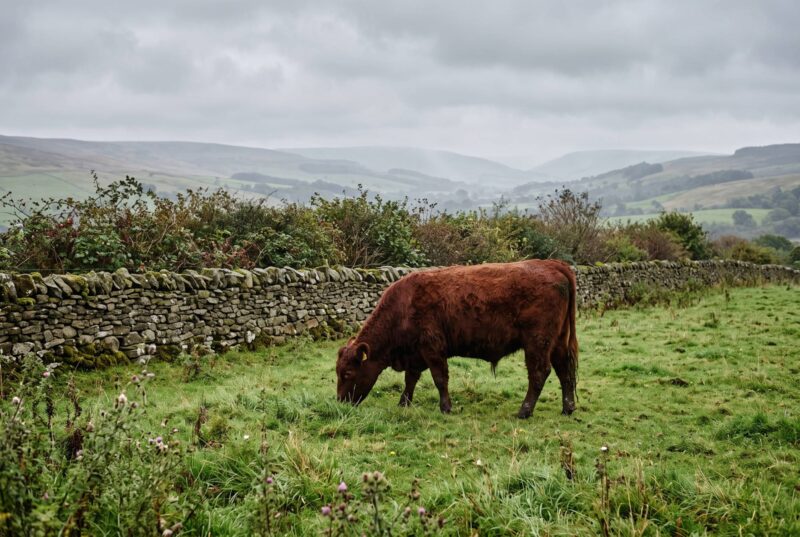
Plant protein needs a factory before it can keep up with meat. The cow is that factory, and she runs on grass.
Sources
- FAO (2013). Dietary protein quality evaluation in human nutrition. FAO Food and Nutrition Paper 92.
- Regulation (EU) No 1169/2011, Annex I: protein calculated as total Kjeldahl nitrogen × 6.25.
- Rutherfurd SM et al. (2015). Protein digestibility-corrected amino acid scores and digestible indispensable amino acid scores differentially describe protein quality in growing male rats. Journal of Nutrition. PMID 25644361.
- Han F et al. (2020). Digestible indispensable amino acid scores (DIAAS) of six cooked Chinese pulses. PMID 33333894.
- Han F et al. (2021). The complementarity of amino acids in cooked pulse/cereal blends and effects on DIAAS. Plants 10:1999.
- Gorissen SHM et al. (2018). Protein content and amino acid composition of commercially available plant-based protein isolates. Amino Acids 50:1685-1695.
- Tang JE et al. (2009). Ingestion of whey hydrolysate, casein, or soy protein isolate: effects on mixed muscle protein synthesis at rest and following resistance exercise in young men. Journal of Applied Physiology 107:987-992.
- Hartman JW et al. (2007). Consumption of fat-free fluid milk after resistance exercise promotes greater lean mass accretion than does consumption of soy or carbohydrate in young, novice, male weightlifters. American Journal of Clinical Nutrition 86:373-381.
- Gorissen SHM et al. (2016). Ingestion of wheat protein increases in vivo muscle protein synthesis rates in healthy older men in a randomized trial. Journal of Nutrition 146:1651-1659.
- Pinckaers PJM et al. (2021). No differences in muscle protein synthesis rates following ingestion of wheat protein, milk protein, and their protein blend in healthy, young males. British Journal of Nutrition 126:1832-1842.
- Pinckaers PJM et al. (2022). Potato protein ingestion increases muscle protein synthesis rates at rest and during recovery from exercise in humans. Medicine & Science in Sports & Exercise 54:1572-1581.
- Hevia-Larraín V et al. (2021). High-protein plant-based diet versus a protein-matched omnivorous diet to support resistance training adaptations: a comparison between habitual vegans and omnivores. Sports Medicine 51:1317-1330.
- Monteyne AJ et al. (2023). Vegan and omnivorous high protein diets support comparable daily myofibrillar protein synthesis rates and skeletal muscle hypertrophy in young adults. Journal of Nutrition 153:1680-1695.
- Orlich MJ et al. (2013). Vegetarian dietary patterns and mortality in Adventist Health Study 2. JAMA Internal Medicine 173:1230-1238.
- Appleby PN et al. (2002). Mortality in British vegetarians. Public Health Nutrition 5:29-36.
- Appleby PN et al. (2016). Mortality in vegetarians and comparable nonvegetarians in the United Kingdom. American Journal of Clinical Nutrition 103:218-230.
- Tong TYN et al. (2020). Vegetarian and vegan diets and risks of total and site-specific fractures: results from the prospective EPIC-Oxford study. BMC Medicine 18:353.
- USDA FoodData Central: top sirloin, lentils, black beans, white rice, peanut butter, quinoa, broccoli, potatoes.
Follow on Twitter (@SamaHoole) or Instagram (@samalifts).
Keep reading
- Ruminants: How A Wet British Hillside Becomes Dinner
- How To Render Tallow And Dripping: The Fat Your Butcher Pays To Throw Away
- British Beef Cuts Explained: The Guide The American Chart Cannot Give You
Map your next 16 weeks of lifting with the free rep ladder planner.
Put it into practice: the 16-Week Apex Programme, sessions built and ladder loaded.

