
A Marine was brought into the medical unit at Camp Ramadi, in western Iraq, with burns over about 70% of his body. His armoured vehicle had gone over a roadside bomb. He had his protective vest on, and under the vest a polyester shirt, and the shirt had melted. It set again on his torso, and the Navy doctors had to cut it off him.
Cook it, then count it
The officer in charge of the unit, Commander Joseph Rappold, said the man would have been less badly hurt if he had put on a different shirt.
On 12 April 2006 a dispatch from Camp Taqaddum announced what Marine commanders in Iraq had decided to do about it. Any Marine going outside the wire was now barred from synthetic athletic clothing containing polyester or nylon, and the dispatch named the labels: Under Armour, CoolMax, Nike.
Under Armour was a favourite with the troops. The military clothing stores sold it, some firms had brought out lines specially for soldiers, and it did exactly what the adverts promised, dragging sweat off the skin in a country where some summer days were expected to touch 54°C. Stars and Stripes added that some of the undershirts the Corps issued itself were polyester too.
The head surgeon of the 1st Marine Logistics Group, Navy Captain Lynn Welling, gave the reasoning in one line. “Burns can kill you and they’re horribly disfiguring,” she said. A roadside bomb is a flash of fire, and a wicking shirt in a flash of fire becomes a layer of hot plastic glued over the burn it is sitting on.
None of it was a secret. Under Armour’s own website warned that its products “may melt in extreme heat that exceeds 350F”, which is about 177°C and a long way short of the inside of a fire. The stock market took the news harder than the Marines did. Under Armour’s sales had risen by more than a third the year before, and when the story broke that week its shares lost 4% in two days of trading.
Pilots and bomb disposal teams had been kept out of polyester for years. The Royal Navy had found out in 1982, when men in polyester coveralls came off the burning ships of the Falklands with melted plastic in their burns.
In January 1984 the US Naval Institute’s journal quoted a Naval Safety Center bulletin on the American sailor’s new dress uniform, called Certified Navy Twill, which it described as “100% polyester despite the salty designation”. The same article recorded an American Army pilot who died of his burns after a crash, his flame-resistant flight suit intact, because the nylon underwear beneath it had melted. His co-pilot, in the same flight suit over cotton underwear, was only slightly hurt.
Welling advised cotton for missions. Cotton catches fire at about 255°C, and it burns without melting into the wound. Wool will not ignite until somewhere between 570 and 600°C, and to keep burning it needs about 25% oxygen in the air around it. The air we breathe holds 21%. So a wool fibre that does catch tends to char, run short of oxygen and put itself out, and at no point does it melt or drip.
The fibre is rich in nitrogen, the element the chemical industry relies on in many of the fire retardants it adds to other materials, and when it is heated hard enough to burn it swells into a layer of char that keeps the heat and the air off whatever is underneath.
After the order, Marine Corps Systems Command asked industry for a knit that would wick sweat without melting or dripping. One chemical firm came back with a blend of nylon and cotton, and the Marines turned it down. The specification they were after had been growing on sheep since long before anybody built Quantico.
That fibre grows on every sheep in Britain, all year round, for nothing. In 2024 the average British fleece paid its farmer 40p a kilo, which on a 2.5kg fleece comes to a pound, and shearing a ewe costs £1.50 to £2.10. A Lincolnshire farmer, Jade Bett, set fire to the fleeces of her 260 sheep because getting them to market would have cost more than the £30 or less they would fetch. One Bonfire Night in Wales, a farmer built a pyre out of 800 fleeces.
The swap has a shape this site keeps running into. Butter lost to margarine and lard lost to Crisco, each time beaten on the price ticket by a factory product whose real costs showed up later, somewhere else, on somebody else’s bill. Wool lost to plastic the same way, and that bill has been coming in ever since, in burns units, in rivers and on a hill of clothes in the driest hot desert on earth.
The best-dressed man on Everest had been dead for 75 years

On 1 May 1999 an American climber called Conrad Anker, searching the north face of Everest for the body of Andrew Irvine, found a man lying face down, frozen into the scree, at just over 8,150 metres. The clothing still had name tags in it. The search party were baffled at first, wondering why Irvine would be wearing George Mallory’s shirt before it dawned on them whose body they had found.
Mallory and Irvine had disappeared near the summit in June 1924. Seventy-five years on, Mallory was still dressed for the climb.
The legend had always been that the 1924 men went up underdressed, a pair of brave amateurs in tweed and knitwear, kitted out for a country walk and beaten by the cold. The body offered the chance to check, because it came with fabric.
Fragments came off the mountain, and between 2002 and 2006 a team led by Mary Rose and Mike Parsons at Lancaster University, with textile specialists from Leeds, Southampton and Derby, rebuilt the whole outfit from them. Next to the skin went layers of silk, wool and cotton. Over the top went a jacket and breeches of gabardine, the tightly woven cloth Burberry patented in 1888, and Burberry made those replicas. Parsons reported that the clothing came out about 20% lighter than its modern equivalent, and the boots about 40% lighter.
Then somebody had to wear it up the mountain. That spring, while the Marines in Iraq were peeling off their Under Armour, a BBC producer called Graham Hoyland was pulling on George Mallory’s underwear. He had a family interest. His great-uncle, Howard Somervell, had been on the 1924 expedition, and had lent Mallory and Irvine his pocket Kodak for the summit attempt. Nobody has found it yet.
Hoyland wore the replicas at base camp, at 5,150 metres, and again above advanced base camp at about 6,340, working for two days beside the expedition leader, who was in a modern down suit. Both of them overheated on the glacier. Hoyland’s verdict was that Mallory’s clothes would have been “more than adequate to climb to the top in”. One reservation was a night out in the open near the summit, which is a reservation every climber has about a night in the open near the summit, whatever they happen to be wearing.
Clothing researchers at the University of Leeds got the same answer in the laboratory: Mallory was insulated well enough to work on Everest so long as he kept moving.
The kit of 1924 weighed less than modern kit and did the job. That modern suit, for its part, would have been a synthetic shell packed with down, so the warm part of the best mountain clothing money can buy is still plucked off a bird.
Premature babies grew faster on lambswool
In 1983 a team in Cambridge put wool to the gentlest test it has ever faced.
They took 34 premature babies of very low birthweight, averaging 1,143g, which is about two and a half pounds, all of them in incubators. Half were allotted at random to be nursed the whole time on lambswool. The other half lay on ordinary cotton sheets.
On the days they were well, the babies on wool put on 22.7g a day and the babies on cotton put on 18.6g. That is about a fifth faster, at a size where every gram is fought for. Counting the days they were ill as well, the wool babies still came out ahead, at 21.5g a day against 18.2g.
The four authors, Stephen Scott, Tim Cole, Penny Lucas and Martin Richards, worked out of the University of Cambridge’s Child Care and Development Group and the Medical Research Council’s Dunn Nutrition Unit. They published in The Lancet that October and concluded, in the careful manner of people writing for The Lancet, that lambswool “seems to have advantages over cotton sheets” for babies this small.
The rival in that trial was cotton, the soft plant fibre in the expensive sheets, and the sheep beat it anyway.
By then the case for wool was sitting in the journals. The clothing trade had stopped reading them a generation earlier.
The fibre that buried wool was invented in a Lancashire printworks
Wool carried Britain for most of its history, and I have told that part elsewhere. What finished it started in 1941, in a laboratory at the Broad Oak Printworks in Accrington, which belonged to the Calico Printers’ Association of Manchester. A building whose whole trade was printing patterns on a plant fibre produced the fibre that would push the animal one off the British back.
The chemists were Rex Whinfield and his assistant James Dickson. They reacted terephthalic acid with ethylene glycol, both made today from fossil fuels, and drew the result out into a thread. They patented it in July 1941. The war kept it secret until 1946. ICI bought the rights in 1947 and began full commercial production in January 1955, under the name Terylene. In America, DuPont sold it as Dacron.
Whinfield had started out as an assistant to Charles Cross and Edward Bevan, the London chemists who in 1892, with Clayton Beadle, patented viscose, the process for dissolving plant cellulose so it could be spun back into thread. Courtaulds bought that patent in 1904 and went on to lead the world in man-made fibre. So two of wool’s great replacements came out of the same small circle of British chemists. The country that had dressed half the world in its sheep spent the twentieth century working out how to stop needing them.
Terylene was strong and shrugged off water. A shirt made of it could be washed and worn again without an iron going anywhere near it. Above all it needed no sheep. A polyester plant needs oil, power and a chemical works. It has no use for a hill, a flock, a dog, a shepherd, a man with clippers or a dry week in June, and it does not care in the slightest what the weather did in April.
That won. In 2024 the world made 132 million tonnes of fibre, more than double the total in 2000. Polyester was 78 million tonnes of it, 59% of everything, and the synthetics together were 69%. Wool, which had kept Europe warm for thousands of years, was 0.9%.
On the farm it came down to arithmetic. I have written about what the collapse did to Sunday dinner, once the sheep stopped being a wool animal that got eaten at the end. The fleece went from income to cost. For years a hill farmer paid more to have his ewes shorn than the wool brought back. In the summer of 2020 the Welsh farmer Gareth Wyn Jones reckoned on about 20p a fleece for the clip off his 1,200 sheep, with the shearers on more than a pound a head.
Polyester won on the price ticket, and the price ticket left a great deal out.
A load of washing sheds 700,000 plastic fibres
In 2016 Imogen Napper and Richard Thompson at the University of Plymouth put fabrics through a domestic washing machine and counted what came out in the waste water. Thompson is the marine biologist credited with coining the word microplastics, in 2004, so he knew what he was looking for.
An average 6kg load of acrylic released more than 700,000 fibres. Polyester released nearly half a million, and polyester-cotton about 138,000. Acrylic is the plastic made to stand in for wool, and it shed the most of all.
New To Carnivore?
Get my Carnivore Guide, free.
The same year a study for Patagonia, run at the University of California’s Bren School in Santa Barbara, found that a single fleece jacket could shed up to 250,000 fibres in one wash. The fleece is the garment people buy to go and look at the countryside in.
Fibres that size, 5 to 8mm long and a fraction of the width of a hair, have been found in the water leaving sewage works, and from there the route runs to rivers and the sea.
Wool sheds too, and New Zealand’s AgResearch has tested what the sea makes of it. Shredded base-layer fabrics went into a seawater test: two kinds of merino, viscose, polyester, nylon and polypropylene. Both wools broke down readily, the machine-washable kind faster than the untreated. Viscose broke down as well. Polyester, nylon and polypropylene showed virtually no biodegradation at all.
Wool is keratin, the same protein as hair and horn, and the bacteria in the sea have had a very long time to work out what to do with hair. They have had about seventy years to work out polyester, and on that evidence they are not getting on well.
The driest hot desert on earth has a hill made of clothes
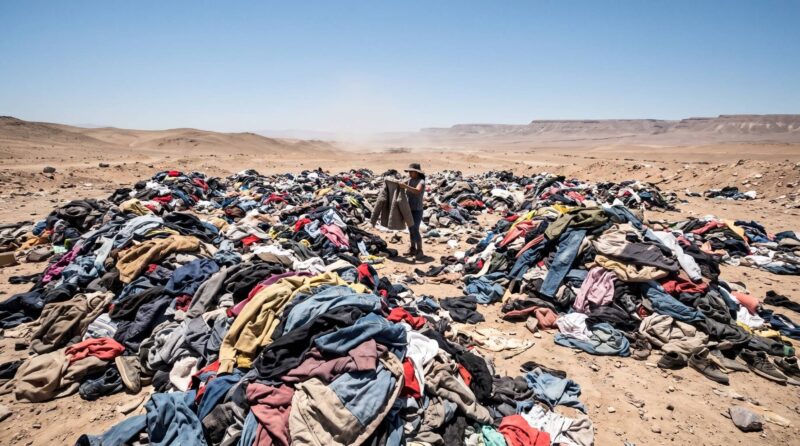
Iquique, in the far north of Chile, has a free trade zone, and every year some 59,000 tonnes of second-hand and unsold clothing lands there from all over the world. Traders pick through it for whatever will sell in Chile or across the border. What will not sell cannot leave the zone unless someone pays the duty, and nobody does. So at least 39,000 tonnes a year, on AFP’s estimate in 2021, goes out into the Atacama around the town of Alto Hospicio and stays there.
AFP’s reporters found Christmas jumpers and ski boots in the driest hot desert on earth. A satellite photographed the spread from orbit in January 2022. Nobody has managed to weigh the whole of it.
The town’s own tip will not take it. Franklin Zepeda, who set up a firm turning the waste into insulation panels, told AFP that municipal landfills refuse the clothing because it does not biodegrade and is full of chemicals. So it lies in the open, and every so often it goes up in flames, and the people of Alto Hospicio shut their windows against the smoke. Migrant women from Venezuela pick through the heaps for something warm, because the desert night is colder than anything they grew up with.
In 2022 the mayor, Patricio Ferreira, told AFP: “We feel abandoned. We feel that our land has been sacrificed.” A lawyer from the region, Paulina Silva, took a complaint to Chile’s environmental court, pointing out that the heaps burn easily and the smoke off them is toxic. In September 2025 Chile’s First Environmental Court found significant damage to the soil and landscape at the illegal dumps and held the state responsible for failing to prevent it. The state appealed.
The industry’s answer is recycling. Less than 1% of the world’s fibre comes from recycled clothing, and most of what gets sold as recycled polyester started life as a drinks bottle rather than a shirt.
Fast fashion was built to be worn a few times. Out on the Atacama it has found the one thing it is genuinely good at, which is lasting.
Bamboo fabric is rayon, and rayon sent its workers to the asylum
The shopper who has heard about microplastics is offered a way out, and these days the way out is bamboo. Bamboo grows like a weed and makes a soft sock.
In 2010 the US Federal Trade Commission wrote to 78 retailers, Wal-Mart, Target and Kmart among them, telling them to stop selling rayon as bamboo. In April 2022 it took two of America’s biggest retailers to court over it anyway. Kohl’s had been selling sheets, pillows, bath rugs and towels as bamboo, which they were in roughly the sense that a newspaper is a pine tree. Walmart had been doing the same.
The FTC’s case was that every one of them was rayon, and that the green claims attached to them were false, because “converting bamboo into rayon requires the use of toxic chemicals” and puts out hazardous pollutants. The two firms agreed to pay $2.5 million and $3 million, the largest penalties the FTC had ever sought for bogus bamboo.
The process is the same whatever plant goes in. The cellulose is soaked in caustic soda, treated with carbon disulphide until it dissolves into a thick syrup, and forced through fine holes into a bath of acid, where it sets as a thread. Bamboo goes in at one end and rayon comes out of the other, which is why American law calls it rayon. Without the carbon disulphide there is no viscose at all.
On the morning of 11 March 1933 a telegram from Wilmington, Delaware reached Dr Alice Hamilton at Harvard Medical School. Hamilton had joined Harvard’s faculty in 1919 as its first woman, and her work in rubber factories in 1915 had made her one of America’s leading experts on carbon disulphide. The telegram, from Petricha Manchester of the Consumers’ League of Delaware, reported a “rayon factory having epidemic of mental cases” and asked her to answer quickly.
She replied the same day with everything she knew and a request for details, and on her carbon copy she later wrote by hand: “No answer ever came.” Paul Blanc, the physician who wrote the history of the industry, identifies the plant as the Delaware Rayon Company at New Castle, which later turned her away with a letter explaining that it did not admit outsiders.
One of its workers, Emily Bowing, sued over what she said were seven weeks in the reeling room in 1934, describing blackouts, nightmares, crying fits and spells of irrationality. Five doctors chosen by the company, a gynaecologist among them, put her suffering down to her domestic circumstances and her physiology, which, coming from that panel, meant her womb. She lost.
Hamilton went on to document psychosis among rayon workers, and she died in 1970, aged 101. The American workplace limit for carbon disulphide stayed at 20 parts per million after a tighter limit, set in 1989, was struck down in the courts in 1992, and Blanc counts it among the least protective in the world, in a trade whose big three producers are now India, China and Indonesia.
That is the fabric now sold as the gentle, natural, plant-based choice. Viscose rots in seawater too; it did in the same tests as the wool. Its trouble all sits at the front end, in the room where the carbon disulphide goes in, and the plant has never once been asked to answer for the factory it gets fed into.
Wool’s front end is a ewe on a hillside eating grass, with a rumen doing the chemistry, and nobody has yet been committed to an asylum by a sheep.
The fleece pays again, and the shearers have gone home
Then the market turned. British Wool’s average payment for the 2025 clip came in at 68p a kilo, up from 40p and the best for ten years, with the core grades of Mule, Texel, Romney, Hill and Cheviot Cross making 70p to 75p and Cheviot 85p. Global demand for crossbred wool had been outrunning supply, and British Wool expects many core grades from the 2026 clip to clear £1 a kilo. On a 2.5kg fleece that is £2.50, against a contractors’ guide rate for shearing a ewe of £1.93.
Phil Stocker of the National Sheep Association said the 2026 clip “could be the one where a fleece pays for its own shearing”. The hill wool is still behind. Welsh wool, off the ewes on the steepest and wettest ground, made 27p a kilo in 2025 and is expected to make about 66p in 2026. British Wool and the sheep association have spent the year asking farmers who kept their clip at home through the bad years to send it in this time, which tells you where some of it has been sitting.
So the fleece is worth taking off again, in the same year the government sent home the people who took it off.
Since 2011 a Home Office concession had let up to 75 shearers in each spring, mostly from New Zealand and Australia, and between them they sheared somewhere between 1.5 and 2 million British sheep a year. Shearing here lasts about three months, which will not keep a full-time shearer for the other nine, so the trade has always run on a small band of professionals following the season round the world.
A New Zealander’s summer is a British winter, and for fifteen years the two seasons fitted together. In 2025 six of them spent three months in Coquetdale, in Northumberland, and sheared nearly 90,000 sheep between the Scottish Borders and County Durham. Chris Armstrong, who farms 850 sheep in upland Northumberland and auctions at Hexham, put the best of them at upwards of 400 sheep a day.
Britain can grow its own. A Staffordshire shearer, Nick Greaves, set the eight-hour world record for lambs in August 2024 with 764 of them. More than 900 people went through British Wool’s shearing and wool handling training in 2025, and over 100 courses were planned for 2026. None of that has closed the gap yet, and a shearer good enough to do 400 a day takes years of seasons to make.
The Home Office tried to end the concession before the 2026 season, relented in March, and granted one final extension to 30 June 2026. “We now expect the sector to complete its transition to using domestic labour,” it said. In the end only 16 overseas shearers came. The government says more than 4,000 people have been trained to shear since 2021. The Conservative MP Robbie Moore put the position more briefly: “When this year’s visas expire, that’s it. The government has closed the door.”
In October 2026 a Home Office minister confirmed that sheep shearers are not on the Temporary Shortage List either, which leaves overseas shearers with no dedicated route in for 2027.
A ewe has to be shorn every year. Leave the fleece on through a British summer and she carries it into the heat and the flies, and flystrike is a slow way for a sheep to die.
Next spring, every ewe on every hill in Britain will be carrying a year’s growth of the one fibre that passed every test in this story, and for the first time in years much of it should be worth more than the cost of taking it off.
Somebody still has to take it off.
Follow on Twitter (@SamaHoole) or Instagram (@samalifts).
Keep reading
- The Vegetarian Movement Began In A Salford Chapel In 1809, Under A Preacher Called Cowherd
- The Chicken: Built In A Cowshed And Sold By A Grocer
- Mad Cow Disease: The Cattle Were Fed Cattle, And The Public Was Fed Reassurance
Set your protein and fat targets in ten seconds with the free macro calculator.

