
Is Grass-Fed Beef Better Than The Grain Version?

Making the jump to red meat can feel like a great way to empty your pockets.
It’s certainly can be more expensive than its main modern counterpart, the chicken breast. And it doesn’t have to be steak. A mash of ground beef, butter and eggs would be more than enough for a lite version of animal-based nutrition.
But the undisputed mainstay of the carnivore way is steak. Easier on digestion, lower in histamine, while richer in flavour. This is where the dilemma comes in. If you were to go into your local supermarket and check out the range of beef, the cheapest cuts are bound to be from grain-fed beef. People with the greediness for the best possible nutrition might go more upmarket for the grass-fed version. That quality comes with a price, so for many that simple switch in taste can really test the weekly budget. So is it worth the extra price hike?
You’d assume that cows raised on mother nature’s pastures will be far healthier than the ones that dine on processed slop. It should mean a clear-cut case, and a weekly trip to your local butchers.
And as it turns out, things aren’t that simple.
Omega 6 – The Real Root Of Evil

Let’s kick things off with a dive into the basics of farm nutrition. The traditional has always been to let animals graze away on the fields, and do their own thing. This has been deeply unsettled over the last century, where tradition has had to make way for mass production. The population boom over the last hundred years has been made possible by revolutionary farming techniques, shuttling in an excess of produce.
But it has come with a catch. These techniques include the manufacturing of highly-processed seed oils that now occupy a huge portion of the modern diet. Easier and cheaper to produce, but also highly inflammatory once it reaches our insides. These seed oils, also known as Omega 6’s and polyunsaturated fats, haven’t been conjured out of thin air. They’ve always been around in the human diet, just not in such stacked quantities. We’re certainly not meant to be storing so much as subcutaneous fat.
The Omega 6 problem shouldn’t be ignored, it wreaks enough damage on its own to wreck an otherwise-decent diet. Here are the major features.
- Causes Insulin Resistance – Rampant carbs fan the flames, but guess what starts all that metabolic dysfunction? Seed oils. These fats deliver the worst of both worlds. They make the fat cells insulin-sensitive, and the peripheral tissues become resistant. Meaning your fat stores always have ample room to grow, while the muscles get their supply chains raided.
- Increases Inflammation – What is inflammation, exactly? It’s the alarm setting for the body, and in this case, it gets triggered by seed oils. Inflammation isn’t inherently a bad, exercise for instance causes inflammation, leading to adaptation. In this case however, we’re looking at the chronic version. Seed oils make their way in, get stored away in the body, then continue to cause problems for the remainder of their stay. Which could be a while.
- Drives Up Hunger – A net cause of the two previous problems, is you’re now also chronically hungry. Foods digest poorly, often causing more inflammation and sugar crashes, leading to rises in ghrelin as the body attempts to balance the books.
With all those issues weighed, it makes sense to limit the effects of Omega 6. One possible way would be to focus on bringing up Omega 3’s to balance out the pro-inflammation with anti-inflammation, but there’s far too much Omega 6 in the standard ‘healthy’ diet. Plant oils, and even the fancy organic jars of olive oil contain some linoleic acid. Nuts, poultry and pork all contain decent amounts.
Limiting these options would definitely put you on the right track to solving inflammation and insulin resistance, but that still leaves us with beef.
The majority of cattle are grain-fed, in accordance with the modus operandum of cutting costs and racking up production. Grains will effectively contain large amounts of seed oils. So there could be a problem here.
The Omega 6 Content Of Grain-Fed Beef

That brings us back around to dealing with the primary topic, and we can try and resolve it by simply looking at the amount of seed oils (Omega 6) found in grain-fed meat.
Pull the numbers out of the USDA food composition database and the argument settles itself. A raw beef top loin steak carries about 260mg of linoleic acid per 100g. The imported grass-fed version of the same cut carries under 100mg. So grass-fed does come in lower. Both are minuscule. Eat a kilo of the conventional stuff and you’ve taken on roughly 2.6 grams of seed oils, about what an ounce of almonds would hand you.
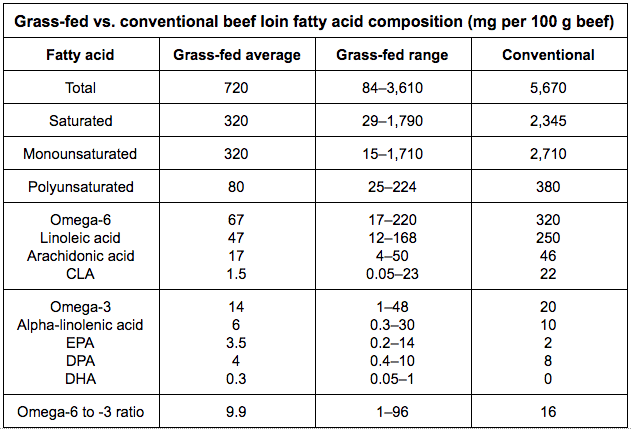
There is still a wide spread in nutrition amongst grass-fed beef. Which is to be expected, as there is still soil quality, floor space, and other qualities that could conceivably result in more nutritious meat. Where grass-fed genuinely wins is the ratio. A review of the fatty acid research puts grass-fed at roughly 1.5:1 omega 6 to omega 3, against 7.6:1 for grain-fed. That gap comes from grass-fed carrying more omega 3, not from grain-fed carrying more omega 6.
Even more importantly, grass-fed cattle are often grain-finished, where they are fattened up over the last few weeks to fetch a better price before slaughter. It’s a caveat of deceptive marketing that can slot right in with the likes of ‘organic’, ‘made with natural products’ and ‘sugar-free’. So it doesn’t seem right to put it on a pedestal as the apex source of nutrition. Grain-fed isn’t far behind enough to warrant a lower slot.
Why Steak Beats Chicken And Pork

That number becomes more insignificant again when you set beef against pork and poultry. Chicken with the skin on runs close to a fifth of its fat as linoleic acid. Pork sits around a tenth. Beef is nearer 4%.
New To Carnivore?
Get my Carnivore Guide, free.
Despite the fact the standard grain chow can certainly be less nutritious than grass, the stomachs of ruminant perform miracles to fix the situation. The foremost of the four stomachs can break down plant toxins while preserving the nutrition, and also converts ingested Omega 6 into saturated fat.
Monogastric animals, such as pork, poultry, and humans, don’t have this trump card. What we eat, we store. Eating that same grain chow would inevitably result in steep climbs in inflammation and insulin resistance.
This mechanic is the primary reason for picking beef over pork and chicken. Despite the variety in how well the cattle are reared, they will still end up being far superior nutrient sources.
Fewer Plant Toxins
Lower Seed Oils
More Saturated Fat
More Minerals And Vitamins
If I were to offer a conclusion here, it would be that you don’t have to obsess over labels, and sit down to wonder whether you’re missing out on a trick by not paying for the upgrade. If you’re eating fatty beef, that’s more than enough, and the rest is a matter of fine margins. That is the whole premise of the Carnivore Diet Plan: buy the cheap fatty cuts, eat them, stop auditing the label.
As for steak over the ground beef, that can certainly be a good choice for lowering histamine content, which can accumulate when exposed to fresh air, and causes a range of rashes and migraines to the sensitive. Steak will also contain less rendered fat, making it easier to digest in larger amounts.
But grass-fed steak over their grain counterparts? Not so much.
Fatty beef, no label anxiety. The Carnivore Diet Plan is the whole thing written down.
Get the Carnivore Diet Plan →Related Reading
- The Halo Ten: Plant Foods That Are Neither Clean Nor Ethical
- Ten Animal Foods That Aren't As Good As You Think
- Forbidden Flesh: Meat Restriction as a Tool of Class Control
- Browse all: Start Here →
The Carnivore Fat Loss Series
This is part of an ongoing series on how carnivore strips body fat without counting calories. See the full hub →
- 7 Fixes For When You're Hungry On Carnivore
- Why Carnivore Outperforms Other Diets For Shedding Pounds
- What Nutrients Are Lacking On A Carnivore Diet?
- What I’ve Changed My Mind On After Four Years Of Carnivore
If you want to put together your own metabolic revival, follow me on Twitter or Instagram, or find out what the coaching programme involves below.
Keep reading
- The Vegetarian Movement Began In A Salford Chapel In 1809, Under A Preacher Called Cowherd
- The Chicken: Built In A Cowshed And Sold By A Grocer
- Mad Cow Disease: The Cattle Were Fed Cattle, And The Public Was Fed Reassurance
Set your protein and fat targets in ten seconds with the free macro calculator.

