
She is forty-one and widowed since March, and the cows come in at half four whether or not she can face them.
The tenancy was in his name. The books are in hers now, along with the calving, the bank, the two boys and the girl, and a funeral tea she catered herself because that was what you did and because the alternative was sitting down. She has not cried in front of anyone since the burial. She cries in the dairy, where the noise covers it, and then she washes her hands and goes in for breakfast. By the third week she has noticed something no amount of talking would have told her, which is that the routine is carrying her. Her hands know what to do when the rest of her does not.
We have a word for her now. We would say she was repressing it. We would say the farm was an avoidance strategy and the dairy was a coping mechanism, and that the real work would have begun the day she finally sat in a room and put the whole thing into sentences.
Her generation is nearly gone and it left almost no explanation of itself, which is how we came to write one on its behalf.
A man walks out of a factory gate in 1963 having been told his job goes at Christmas. He rides home, eats his tea, listens to the football results and says nothing for two days, until he has been to see about the work going at the depot. Then he tells his wife in one sentence, along with what they are going to do about it. She is furious about the two days for the rest of her life and tells the story every Christmas for twenty years.
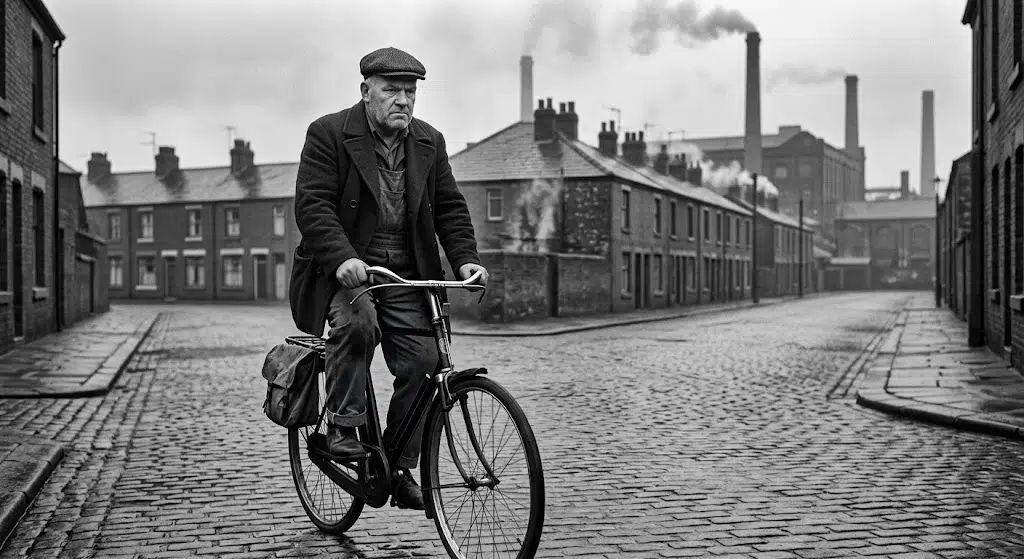
The modern reading is that he could not be vulnerable with his own family. His reading was that the news would be exactly the same news on Thursday, and that walking through his own front door carrying nothing but a problem was a thing a man could choose not to do. He had the feeling all the way home on the bike. He declined to let it speak first.
The house where nothing was said
Plenty of it was rot, and the damage was real.
Men came back from Burma and Normandy and said nothing for forty years, and drank, and went quiet in a way their children learned to read from the sound of the back door. Women were sent home from maternity wards with empty arms and told that these things happen and that another baby would put it right. Girls were hurt and did not tell, because there was nobody to tell and no language that would have survived being spoken out loud in that kitchen. Marriages rotted in silence because there was nowhere for them to go. A good deal of what passed for composure was a man in a chair by the fire while everyone in the house moved around him quietly for thirty years.
That is the half that made a noise, and it is the half we spent thirty years correcting. The silence that was working made no noise at all, and we have been writing its obituary ever since without ever having noticed it in the room.
The difference that got lost
Repression, in the sense the word was invented for, is a thing that happens to a man rather than a thing he does. The feeling goes down out of reach, unavailable to him, and turns up years later as a temper, a stomach, a drink, a habit of leaving the room when a certain year is mentioned. The veteran who cannot say the word Burma is not exercising judgement. He has been overwritten.
The widow in the dairy is doing something else entirely, and she could tell you exactly what it is if anyone asked her, which is the whole test. She knows what she feels. She could name it in one sentence. She has decided where it goes and when, and she has decided that it does not go in front of the children before school and it does not go in front of the bank manager. Her grief is not lost to her. It has a place, and the place is the dairy at half four, and the reason she can hold that line at breakfast is that she is not pretending the place does not exist.
Those two men and that one woman got collapsed into a single diagnosis somewhere in the last fifty years, and once they were collapsed there was only one prescription left to write. Say it out loud, say it to someone, say it soon, and say it in the room where it is meant to be said. That instruction is medicine for the first man. Handed to the widow, it is an instruction to stop doing the one thing that is currently holding her up.
The insult we borrowed
The phrase we convict them with is not even ours.
The stiff upper lip is American. Its earliest known appearance is in the Massachusetts Spy in 1815, and it ran through the young republic for most of the century as straight praise: nerve, self-possession, not making a poor mouth about your circumstances. Haliburton’s Yankee clockmaker says it. Harriet Beecher Stowe puts it in Uncle Tom’s Cabin in 1852. Twain uses it. It does not turn up in a British source until 1844, by which point the Americans had been keeping their upper lips stiff for thirty years and were exporting the habit along with the books.
The defining charge against British emotional life was imported, and it arrived as a compliment. It curdled into a diagnosis later, once the empire was gone and something was needed to blame.
In April 1920 Lord Southborough rose in the House of Lords and asked for an inquiry into shell shock. He got one. The War Office committee sat for two years, took evidence from fifty-nine witnesses including army officers, neurologists, doctors who had worked the clearing stations and men who had broken down themselves, and published as a command paper in 1922. Its conclusions are a mess of the enlightened and the reactionary, the way everything from that decade is. It accepted that any man will break given long enough under those conditions, which is a startling thing to find written down by a room largely made up of colonels, and in the same breath it recommended abolishing the term and improving morale.
Four years after the Armistice, the state ran a public inquiry into the interior lives of its soldiers and printed the transcript. By 1939 something like 120,000 British veterans of that war were still drawing pensions for psychiatric disability, roughly a sixth of every pensioned disability the war produced. This is the era we describe as incapable of discussing feelings. They discussed them in the Lords, in Whitehall and on the pension rolls for the next twenty years, and they paid out on them for longer than most of us have held a job.
Ritual without narration
Grief is where the misreading runs furthest backwards from what everyone assumes.
That generation and the one above it had an entire public architecture for mourning. Deep mourning and half mourning, with fixed periods for each. Crape on the sleeve and on the door. Jet jewellery. Black-edged notepaper, so the recipient knew before he opened it. Blinds down the whole street rather than the one house. Neighbours arriving with food, unasked, leaving without requiring a conversation. A funeral tea. A year in which nobody expected you to be yourself, and a day on which the expectation quietly resumed.
None of it obliged anyone to say a word about how they felt. All of it told a bereaved woman that what had happened to her was enormous and that she would be carried over the worst of it on rails.

We reversed the arrangement exactly. We talk about grief constantly, in a vocabulary of stages and processing and closure, and we have almost nothing that a person actually does. Three days of compassionate leave. A group chat that goes quiet after a fortnight because nobody knows the form. An unspoken expectation of being broadly back to normal by the following month, since the structure that used to hold the door open for a year is gone and nothing was built in its place. Ritual without narration held people up. Narration without ritual leaves a woman standing in her kitchen at four in the afternoon with a great deal of accurate language for what is happening to her and nothing to do with her hands until teatime.
New To Carnivore?
Get my Carnivore Guide, free.
Take all the time you need
The kindest sentence we have invented is the one that cuts the rope.
Take all the time you need. Look after yourself first. Do not push yourself. Every one of those is meant warmly and every one of them removes the only scaffolding a person in trouble has, which is the set of things that have to be done today by them and nobody else. The animals still want feeding. The child still wants collecting at three. The shift still starts at six and the man on it still needs relieving. Obligation is not the enemy of a person in distress. Obligation is frequently the last handrail on the stairs, and their generation had it screwed to the wall in every room of the house.
The women had most of it, and got the least credit for having it. The man by the fire had gone somewhere none of them could follow, and it was his wife who kept the house running around the hole he had left in it: the money, the children, the visitors managed at the door, the explanations offered to nobody, the decades of it. Her composure was not a lesser version of his silence. It was the load-bearing wall of that family, and it has never once been described as heroism in any documentary I have watched about the men who came home quiet.
What they were actually doing
Every part of that has a name, and the name has been on the shelf for two thousand years.
Epictetus taught that an impression arrives on its own, and that your assent to it is a separate act which remains yours to give or withhold. Fear turning up is the weather. Deciding while afraid is the work, and it is the only part of the business anybody owns. Marcus Aurelius reminds himself in his notebook, over and over, that the harm is not in the event but in his verdict on the event, which is the note of a man who kept needing reminding. Seneca wrote a long letter to a woman years into mourning her son and spent none of it telling her the grief was an error.
What they held was a claim about hierarchy. A feeling is real, it is information, it is entitled to be felt in full, and it does not get to issue orders. The widow in the dairy was not denying a thing. She had simply declined to accept that her grief was entitled to command the milking, and she was correct, because it was not.
The people who built this were not comfortable men looking for a hobby. Epictetus was born a slave, was lame all his life, and was still teaching after Domitian threw the philosophers out of Rome. Marcus opens his notebook with a long list of debts, page after page of what he owes his mother, his grandfather, his tutors, his wife, thanking a man for teaching him to write a letter without airs, which is not the work of somebody who had shut his heart in a drawer. The whole apparatus was aimed at living well and being useful to the people in front of you. Endurance was the floor of it rather than the point.
Their generation never called it Stoicism. They called it getting on with it, and they had it by inheritance rather than by reading, the way you inherit a way of holding a cup. It came down through churches, regiments, mothers and the sheer arithmetic of a life where the children still had to be fed by someone whose own father had just died. The reasoning had worn off centuries earlier and only the posture survived. Then we found the posture with nothing visible behind it, diagnosed it as an injury, and taught two generations that a strong feeling is a verdict already delivered.
The philosophy, now available as a medallion
The word means something entirely different today, and what it means is available in pewter.
You can buy a bust of Marcus Aurelius, hand-sculpted, individually numbered, aged verdigris finish, mounted on a cherry base with an espresso stain. You can buy eight medallions to keep it company, cheaper as a bundle, struck by a mint that has been running in Minnesota since 1882. One of the coins is there to remind you that you are going to die. There is a signet ring if the coin lacks conviction, a deck of challenge cards, a membership tier, a private discussion board, and several hundred dollars of fresh content a year to keep the practice ticking over.
Marcus wrote none of it for anyone. The book is a private notebook, kept in the field, never prepared for publication and never given a title by the man who wrote it. The most profitable self-improvement property of the past decade is a pile of notes a tired man made to stop himself becoming the thing his job gave him the power to become, and it has been turned into a range.
The rest of the revival is worse, because the rest of it is exercise. Cold water at dawn, the four o’clock alarm, the jaw, the obstacle as opportunity, discomfort taken deliberately and then filmed. All of it is optional. All of it can be stopped the moment it stops being enjoyable. All of it gets announced, and the announcement is the tell, because a practice built for people who could not opt out of anything has been repackaged as a hobby for people who can opt out of everything, and a hobby needs an audience.
The widow could not get out of the milking. The man at the factory gate could not get out of Christmas. Nothing in front of either of them was elective, nobody was watching, and there was no version of it that involved telling anybody they were doing it.
The medallion in your pocket says remember that you will die. Your grandmother had buried her mother, a brother and a child, and she had the shop open at eight.
Next in this strand: the lost virtue of keeping something to yourself, and why ordinary people once expected life to be hard.
Follow on Twitter (@SamaHoole) or Instagram (@samalifts).

