
Lean beef, sliced thin and dried until it snaps rather than bends, ground to a powder, and mixed with roughly its own weight in rendered beef tallow. Press it, let it set, keep it somewhere cool and dark. That is the whole recipe and there is no third ingredient unless you want one.
Cook it, then count it
The part that catches everybody out is that a food which finishes up half fat by weight begins with you cutting every scrap of fat off the meat.
Makes about 440g from 750g of trimmed raw beef. That is roughly 220g of dried meat powder and roughly 220g of tallow.
Why you trim the fat off a food that is half fat
Pemmican has two enemies and the entire method is built around them.
The first is water. Water is what lets bacteria and mould live, so the meat has to be dried well past the point most people stop. Not chewy, not leathery, not jerky. Brittle. A strip should snap or crumble between your fingers, and if it bends at all it is not finished and the finished block will not keep.
The second is oxygen, which turns fat rancid, and this is where the paradox comes apart, because the two fats on the same animal do not behave the same way at all. The fat marbled through the muscle goes off quickly and there is nothing you can do about it once it is sitting inside the meat powder. Rendered tallow does not, because rendering drives the water and the protein out and leaves you with something close to pure fat, which is stable, and which then coats the dried meat and shuts the air out.
So the fat inside the meat is the thing that spoils your pemmican and the fat you add to it is the thing that preserves it. Same animal, opposite jobs. Trim ruthlessly, render properly, and the two ingredients stop fighting each other.
Jerky is dried meat with a clock running on it. Pemmican is dried meat sealed inside fat, which is why one of them lives in a packet with a date on and the other one crossed a continent.
What to buy
Ask for topside or silverside, the leanest thing on the counter, and trim it hard. Every visible speck. You are not being wasteful, because you are about to put fat back in a form that keeps.
For the tallow, beef fat rendered down yourself beats anything in a tub. If you are buying suet, check the box says beef, because the vegetable stuff sold alongside it is palm and sunflower oil with wheat flour through it, and putting that in this recipe would undo the point of the whole exercise.
Fresh beef loses roughly seventy per cent of its weight in drying, so start with more than you think you need.
The method
Slice it thin. About 3mm, roughly an eighth of an inch, across the grain. A thick strip dries on the outside and stays damp in the middle, and that damp middle is what spoils the batch three weeks later. Part freezing the joint for half an hour makes thin slicing far easier.
Dry it until it snaps. A dehydrator at 70C for eight to twelve hours, or the oven on its lowest setting, around 75C, with the door propped slightly open, for something nearer fifteen. Time is not the test. Take a strip out, let it cool, and bend it. Cooled meat that flexes needs longer. Cooled meat that cracks and crumbles is ready.

Grind it to a powder. Food processor, in batches, until it is closer to coarse flour than to flakes. Powder packs tight and lets the fat coat every surface, which is what does the sealing. Chunks leave air pockets, and air is the enemy you have just spent a day preparing for.
Render the tallow properly. Beef fat, chopped small, in a low oven or a heavy pan on the lowest heat until it has melted and gone clear, then strained through a sieve or muslin until there is not a solid left in it. Cloudy tallow still has water and protein in it and both of them shorten the life of the finished block. It should pour like oil and set hard and white.
Combine while the fat is liquid but not hot. Pour it into the meat powder a little at a time and work it until every particle is wet through and the mixture holds when you squeeze a handful. Equal weights is the traditional starting point. More fat gives you something softer and richer that eats better, less gives you something drier that keeps longer.
Press it and let it set. Into a tray lined with parchment, pressed down hard to drive the air out, then left somewhere cool until firm. Cut it into blocks once it is solid.
New To Carnivore?
Get my Carnivore Guide, free.
Keeping it
Cool, dark, airtight. Light and air are what turn the fat, so a tin or a vacuum bag in a cupboard beats a jar on a windowsill by a distance.
Properly made, which means the meat was brittle and the tallow was clear, it keeps for years without refrigeration, and that is the entire reason the food exists. The specific numbers that get thrown around, five years, fifty, a hundred, come from blogs quoting other blogs, and the honest answer is that it depends completely on how well you did those two steps.
If it ever smells like old crayons or cheap paint, that is the fat oxidising and the block goes in the bin. That is the only failure mode worth learning and it announces itself.
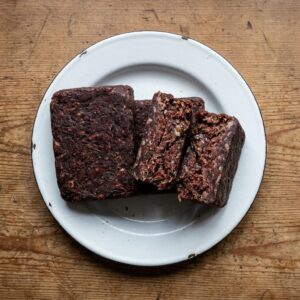
How To Make Pemmican
Equipment
- Dehydrator or oven
- Food processor
- Sieve or muslin for straining the tallow
Ingredients
- 750 g topside or silverside trimmed of every visible speck of fat
- 220 g beef tallow rendered until clear and strained, roughly equal to the dried meat weight
Instructions
- Trim the beef of every visible speck of fat, then part freeze it for half an hour and slice it about 3mm thick across the grain. A thick strip dries on the outside and stays damp in the middle, and that damp middle is what spoils the batch.
- Dry it until it snaps. A dehydrator at 70C for eight to twelve hours, or the oven on its lowest setting around 75C with the door propped slightly open for nearer fifteen. Time is not the test: take a strip out, let it cool, and bend it. If it flexes it needs longer. If it cracks and crumbles it is ready.
- Grind the dried meat to a powder in a food processor, in batches, until it is closer to coarse flour than to flakes. Powder packs tight and lets the fat coat every surface. Chunks leave air pockets.
- Render the tallow. Beef fat chopped small, in a low oven or a heavy pan on the lowest heat until melted and clear, then strained through a sieve or muslin until no solids remain. Cloudy tallow still holds water and protein and both shorten the life of the block. It should pour like oil and set hard and white.
- Combine while the fat is liquid but not hot. Pour it into the meat powder a little at a time and work it until every particle is wet through and a squeezed handful holds together. Equal weights is the traditional starting point: more fat eats better, less fat keeps longer.
- Press it into a parchment lined tray, pushing down hard to drive the air out, and leave it somewhere cool until firm. Cut into blocks once solid.
- Store cool, dark and airtight. A tin or a vacuum bag in a cupboard beats a jar on a windowsill. If it ever smells like old crayons or cheap paint the fat has oxidised and the block goes in the bin.
Rendering your own tallow is the whole game here. Bring Back the Dripping is thirty three lost British recipes built on exactly that: dripping, suet crusts, joints roasted in beef fat, from back when this country cooked on the fat it had.
Get Bring Back the Dripping →What about the berries
Traditional pemmican often carried dried berries, and if you want them in, they have to be genuinely dry, because anything holding water is working against everything above.
I would leave them out. They were in the original for want of anything else to put in it, the block keeps better without them, and nobody has ever opened a tin of this and thought it needed fruit.
Questions people actually ask
What meat is best for pemmican? The leanest you can get. Topside or silverside, trimmed of every visible scrap of fat. The fat marbled through the muscle goes rancid and will spoil the finished block, which is why the recipe adds fat back separately as rendered tallow.
How dry does the meat need to be? Brittle. Let a strip cool, then bend it. If it flexes at all it needs longer. If it snaps or crumbles it is ready. Leathery is jerky, and jerky does not keep the way pemmican does.
What is the ratio of meat to fat? Roughly equal weights of dried meat powder to rendered tallow is the traditional starting point, commonly run anywhere from about forty to sixty either way. More fat eats better, less fat keeps longer.
Can I use butter or lard instead of tallow? Butter has water and milk solids in it and will not keep, though ghee will, because clarifying it takes both of those out. Lard sets softer and turns faster than beef tallow, because pig fat is a printout of whatever the pig was fed and commercial pigs are fed grain. Beef tallow is the traditional choice for the same reason it is the right one.
Do I need a dehydrator? No. The oven on its lowest setting with the door propped ajar does the same job and takes longer. The propped door is doing real work, letting the moisture leave rather than recirculating it around the meat you are trying to dry.
Why does mine taste of nothing? Because it is meat and fat and nothing else, which is what it is supposed to be. It was built to be carried and eaten rather than admired at a table. If it tastes of genuinely nothing, the tallow is the place to look, because good beef fat off a grass fed animal carries most of the flavour in the block and cheap tub tallow carries none.
Follow on Twitter (@SamaHoole) or Instagram (@samalifts).
Keep reading
- The Vegetarian Movement Began In A Salford Chapel In 1809, Under A Preacher Called Cowherd
- The Chicken: Built In A Cowshed And Sold By A Grocer
- Mad Cow Disease: The Cattle Were Fed Cattle, And The Public Was Fed Reassurance
Not sure a food belongs on the plate? Check it in two seconds with the free Can I Eat It tool.
Cook like this every night: Bring Back the Dripping, 140 pages of fat-first British cooking.

