
Mutton shoulder, salted a day ahead, covered, in a 120C oven until a probe in the thickest part reads 90 to 95C. On a shoulder of two to three kilos that will take somewhere between six and eight hours, but the clock is an estimate and the probe is the answer, and further down I will explain why that distinction matters more with mutton than with any other joint in the butcher’s window.
Cook it, then count it
Why mutton does not cook like lamb
Everybody who tries mutton once and gives up makes the same mistake, and it is not really their fault. They cook it like lamb, only for longer, and it comes out dry and still tough. Then they conclude the meat was the problem.
The meat was not the problem. Mutton is not lamb with more mileage on it. The connective tissue in it is chemically a different substance and it behaves differently in heat.
Collagen is held together by cross-links. In a young animal those cross-links are divalent and heat labile, which is a technical way of saying they fall apart when you warm them. That is why a shoulder of five month old lamb goes tender in a couple of hours, and why more or less any method works on it.
As an animal ages, those cross-links undergo condensation reactions and turn into something else: trivalent, mature, heat stable cross-links, principally a compound called pyridinoline. Its concentration rises steadily with the age of the animal, and it has been measured in sheep specifically rather than assumed from cattle. Crucially, it is the mature cross-links rather than the total quantity of collagen that decide how tough the cooked meat is. A two year old sheep does not have dramatically more connective tissue than a lamb. It has connective tissue that has been chemically welded shut.
Heat stable means what it says. Those bonds do not surrender to temperature. The heat solubility of collagen falls as the animal gets older, so the collagen in mutton will not dissolve as readily as a lamb’s at any temperature you can produce in a domestic oven.
Which is why turning the oven up makes it worse
This is the bit worth holding on to, because it is the opposite of what instinct says.
Collagen converts to gelatin somewhere around 71 to 82C, but the conversion is slow and partial: on the order of five to ten per cent at 64 to 70C, and seven to fifteen per cent at 75 to 85C when it is only held there briefly. The word doing the work in that sentence is briefly. What converts collagen is not a higher number on the dial. It is hours spent inside the window.
Meanwhile the muscle fibres are doing the opposite thing. Push them past roughly 65 to 70C and they contract and squeeze their water out. So a hot fast cook dries the meat while the cross-links are still holding, and you get the worst of both at once: tough and dry. That is the mutton people remember, and it is a cooking failure rather than a property of the animal.
The same age that gave this meat its flavour is what gives it its heat stable cross-links. One property, two consequences, and the entire method below is built on trading time for the second one so you get to keep the first.
The thing nearly every mutton recipe gets wrong
Two things, actually, and they are both about numbers.
The first is the internal temperature. You will find guidance telling you to cook a shoulder to 65C, which is described as medium. Do not do that to mutton. 65C is precisely the worst place to stop: hot enough that the muscle fibres have already contracted and given up their water, nowhere near hot enough or long enough for mature cross-links to have converted to anything. You have paid the full price in moisture and collected none of the reward. Shoulder is not a joint you cook to pink. The target is 90 to 95C, which is where the collagen has actually gone and the meat shreds under a fork.
The second is the clock. Every recipe you will read, including good ones from butchers who genuinely know mutton, gives you hours: six to eight at 120C, four to five at 150C. Those are reasonable estimates and I have given you one myself at the top. But there is no legal definition of mutton in this country, so the word covers anything from two years old to five and beyond, and pyridinoline accumulates the whole time. A five year old shoulder has meaningfully more heat stable cross-linking in it than a two year old one and needs longer to get to the same place. You usually do not know which animal you have, and quite often neither does the person who sold it to you.
So a fixed time is a guess about an animal whose age you were never told. Buy a probe thermometer. It is the single biggest upgrade available to anyone cooking this meat, it costs less than the joint, and it turns a gamble into a finishing condition.

The method
Salt it the day before. Sea salt, generously, all over, then leave it uncovered on a rack in the fridge for twenty four hours, or up to two days on a big shoulder. This is a dry brine and it does three things: the salt draws out surface moisture, dissolves in it, then carries back into the meat, modifying the proteins so they hold water better through a long cook. It also dries the surface, which browns far better than a wet one. On a joint that is going to spend most of a day losing moisture, starting with better water retention is not optional, it is the cheapest advantage on offer.
Take it out of the fridge a couple of hours before it goes in. A cold joint just extends the time it takes to get through the window.
Do not trim the fat. The cap bastes the joint continuously for the entire cook and it is the only thing standing between six hours of oven and a dry shoulder. If somebody has already trimmed it for you, ask for a piece of mutton or beef fat and lay it over the top.
Bone in. The shoulder is several hard working muscles around a complicated bone and it is easier to cook whole and pull afterwards than to wrestle boned and rolled. The bone coming clean away is also your second doneness signal after the probe.
Into a 120C oven, covered. Sit it in a roasting tin, add a splash of water or bone stock to the bottom, and cover the whole tin tightly, parchment then foil. The low oven is deliberate: it puts less heat into the outside of the joint while the middle takes its hours, so you get less overcooked meat at the edges. The cover traps the steam that the muscle is shedding anyway and keeps the surface from drying while you wait.
New To Carnivore?
Get my Carnivore Guide, free.
Leave it alone for five hours, then start probing. Thickest part, away from the bone. You are looking for 90 to 95C, and you may find it at six hours or you may still be an hour or two short. Older animal, longer wait. That is the whole point.
Uncover for the last half hour if you want the outside to firm up and colour, and baste it with what is in the tin when you do.
Rest it for an hour, covered. This is not optional and an hour is not a typo. Gelatin sets as it cools and the joint reabsorbs a good deal of what is sitting in the tin. A shoulder rested for ten minutes is a noticeably worse thing than the same shoulder rested for sixty.
Then pull it apart with two forks. If it fights you, it was not done, and the answer is another hour in the oven rather than a sharper knife.
Keep the fat and the juices. What is in that tin is rendered mutton fat and gelatin, and pouring it away is throwing out the best thing in the oven. Spoon it back over the pulled meat, or set it aside and cook in it for the next fortnight.
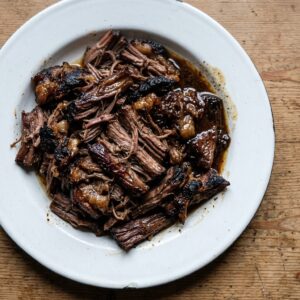
Slow Roast Mutton Shoulder
Equipment
- Probe thermometer the single biggest upgrade for this joint
- Roasting tin
- Parchment and foil
Ingredients
- 2 kg mutton shoulder bone in, 2 to 3kg, fat cap left on
- 2 tbsp flaky sea salt roughly, enough to cover all surfaces
- 100 ml water or bone stock a splash for the tin, not a pool
Instructions
- Salt it the day before. Season the shoulder generously all over with sea salt, sit it on a rack, and leave it uncovered in the fridge for 24 hours, up to 48 on a large one. The salt draws out surface moisture, dissolves, and carries back into the meat, so it holds water better through a long cook.
- Take it out of the fridge about two hours before it goes in the oven. A cold joint only lengthens the time it spends getting through the collagen window.
- Heat the oven to 120C. Sit the shoulder in a roasting tin, fat cap up, and add a splash of water or bone stock to the bottom of the tin.
- Cover the tin tightly, parchment first then foil. You are trapping the steam the meat is already giving up, and keeping the surface from drying out while the middle takes its hours.
- Leave it alone for five hours, then start probing the thickest part, away from the bone. You are looking for 90 to 95C. It may arrive at six hours or it may take eight. An older animal takes longer, and you usually do not know how old yours was.
- Uncover for the last half hour if you want the outside to colour and firm, basting with what has gathered in the tin.
- Rest it for a full hour, loosely covered. Gelatin sets as it cools and the joint reabsorbs a good deal of the tin. An hour is not a typo.
- Pull it apart with two forks. If it fights you it was not finished, and the answer is another hour in the oven rather than a sharper knife. Spoon the rendered fat and juices back over the meat, and keep whatever is left to cook in.
Nutrition
One shoulder is a start. The Carnivore Kitchen is sixty three recipes, every one of them built to clear a fat to protein ratio of at least one to one, with the numbers printed on the card.
Get The Carnivore Kitchen →If you want the old version
Before there were fridges, this joint was often cooked submerged in fat and then stored under it, which is what confit means. Salt the meat, hold it a day, then cook it slowly in enough rendered fat to cover, low, for hours, and let it cool down in the fat rather than lifting it straight out.
It is more fat than most people have to hand, and you get it all back at the end. It is also the single most forgiving way to cook an old animal, because meat sitting in fat cannot dry out while it waits for its cross-links to give way, and the waiting is the entire problem with mutton.
Questions people actually ask
What temperature should mutton shoulder be cooked to? 90 to 95C internal, measured in the thickest part away from the bone. That is where the mature collagen cross-links have converted to gelatin and the meat shreds. Ignore any guidance pointing you at 65C, which is a figure for a pink roasting joint and will give you mutton that is both dry and tough.
How long does a mutton shoulder take? Six to eight hours at 120C for a two to three kilo bone-in shoulder, but treat that as a planning estimate rather than a rule. Mutton can be anything from two years old to five, older animals have more heat stable cross-linking, and the same joint weight can want a couple of extra hours. Cook to the probe.
Can I do it in a slow cooker? Yes, and it is a good match for exactly the reason described above: a slow cooker is a sealed, moist, low environment, which is what this meat wants. You lose the roasted surface, so brown it first if that matters to you.
Do I need to add liquid? A splash, not a pool. You are covering the tin to keep the steam in, not braising it in stock. The joint will give up plenty of its own.
Why is my mutton still tough after six hours? Almost always because it is not finished rather than because it is ruined. Tough at temperature usually means it has not held long enough in the conversion window, or the oven runs cool, or the animal was older than you thought. Put it back covered and give it another hour. Mutton is very hard to overcook at 120C and very easy to undercook.
Follow on Twitter (@SamaHoole) or Instagram (@samalifts).
Keep reading
- The Vegetarian Movement Began In A Salford Chapel In 1809, Under A Preacher Called Cowherd
- The Chicken: Built In A Cowshed And Sold By A Grocer
- Mad Cow Disease: The Cattle Were Fed Cattle, And The Public Was Fed Reassurance
Not sure a food belongs on the plate? Check it in two seconds with the free Can I Eat It tool.
Cook like this every night: Bring Back the Dripping, 140 pages of fat-first British cooking.

