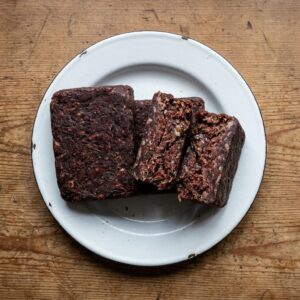
How To Make Pemmican
Lean beef dried until it snaps, ground to a powder and bound with roughly its own weight in rendered beef tallow. The fat inside the meat is what spoils it and the fat you add is what preserves it.
Equipment
- Dehydrator or oven
- Food processor
- Sieve or muslin for straining the tallow
Ingredients
- 750 g topside or silverside trimmed of every visible speck of fat
- 220 g beef tallow rendered until clear and strained, roughly equal to the dried meat weight
Instructions
- Trim the beef of every visible speck of fat, then part freeze it for half an hour and slice it about 3mm thick across the grain. A thick strip dries on the outside and stays damp in the middle, and that damp middle is what spoils the batch.
- Dry it until it snaps. A dehydrator at 70C for eight to twelve hours, or the oven on its lowest setting around 75C with the door propped slightly open for nearer fifteen. Time is not the test: take a strip out, let it cool, and bend it. If it flexes it needs longer. If it cracks and crumbles it is ready.
- Grind the dried meat to a powder in a food processor, in batches, until it is closer to coarse flour than to flakes. Powder packs tight and lets the fat coat every surface. Chunks leave air pockets.
- Render the tallow. Beef fat chopped small, in a low oven or a heavy pan on the lowest heat until melted and clear, then strained through a sieve or muslin until no solids remain. Cloudy tallow still holds water and protein and both shorten the life of the block. It should pour like oil and set hard and white.
- Combine while the fat is liquid but not hot. Pour it into the meat powder a little at a time and work it until every particle is wet through and a squeezed handful holds together. Equal weights is the traditional starting point: more fat eats better, less fat keeps longer.
- Press it into a parchment lined tray, pushing down hard to drive the air out, and leave it somewhere cool until firm. Cut into blocks once solid.
- Store cool, dark and airtight. A tin or a vacuum bag in a cupboard beats a jar on a windowsill. If it ever smells like old crayons or cheap paint the fat has oxidised and the block goes in the bin.
Tried this recipe?Let us know how it was!