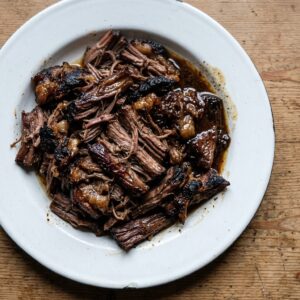
Slow Roast Mutton Shoulder
Mutton shoulder, salted a day ahead, covered, in a 120C oven until a probe reads 90 to 95C. Older animals carry more heat stable collagen cross-links, so cook to temperature rather than to the clock.
Equipment
- Probe thermometer the single biggest upgrade for this joint
- Roasting tin
- Parchment and foil
Ingredients
- 2 kg mutton shoulder bone in, 2 to 3kg, fat cap left on
- 2 tbsp flaky sea salt roughly, enough to cover all surfaces
- 100 ml water or bone stock a splash for the tin, not a pool
Instructions
- Salt it the day before. Season the shoulder generously all over with sea salt, sit it on a rack, and leave it uncovered in the fridge for 24 hours, up to 48 on a large one. The salt draws out surface moisture, dissolves, and carries back into the meat, so it holds water better through a long cook.
- Take it out of the fridge about two hours before it goes in the oven. A cold joint only lengthens the time it spends getting through the collagen window.
- Heat the oven to 120C. Sit the shoulder in a roasting tin, fat cap up, and add a splash of water or bone stock to the bottom of the tin.
- Cover the tin tightly, parchment first then foil. You are trapping the steam the meat is already giving up, and keeping the surface from drying out while the middle takes its hours.
- Leave it alone for five hours, then start probing the thickest part, away from the bone. You are looking for 90 to 95C. It may arrive at six hours or it may take eight. An older animal takes longer, and you usually do not know how old yours was.
- Uncover for the last half hour if you want the outside to colour and firm, basting with what has gathered in the tin.
- Rest it for a full hour, loosely covered. Gelatin sets as it cools and the joint reabsorbs a good deal of the tin. An hour is not a typo.
- Pull it apart with two forks. If it fights you it was not finished, and the answer is another hour in the oven rather than a sharper knife. Spoon the rendered fat and juices back over the meat, and keep whatever is left to cook in.
Tried this recipe?Let us know how it was!