
Every flock has a hierarchy, and in Iceland one animal in the flock has been bred to sit at the top of it for a thousand years. Not the biggest. Not the best fed. The one with an opinion.
They are called forystufé. Leader sheep.
You can pick one out of a hundred at fifty yards. Taller, longer in the leg, thin through the body, oddly marked, black or brown and nearly always patched with white. Where the flock has its head down, the leader has its head up. Big dark eyes, going over everything. It walks with a harder, quicker gait than the rest, something close to a trot.
And it goes first. Not sometimes. First.
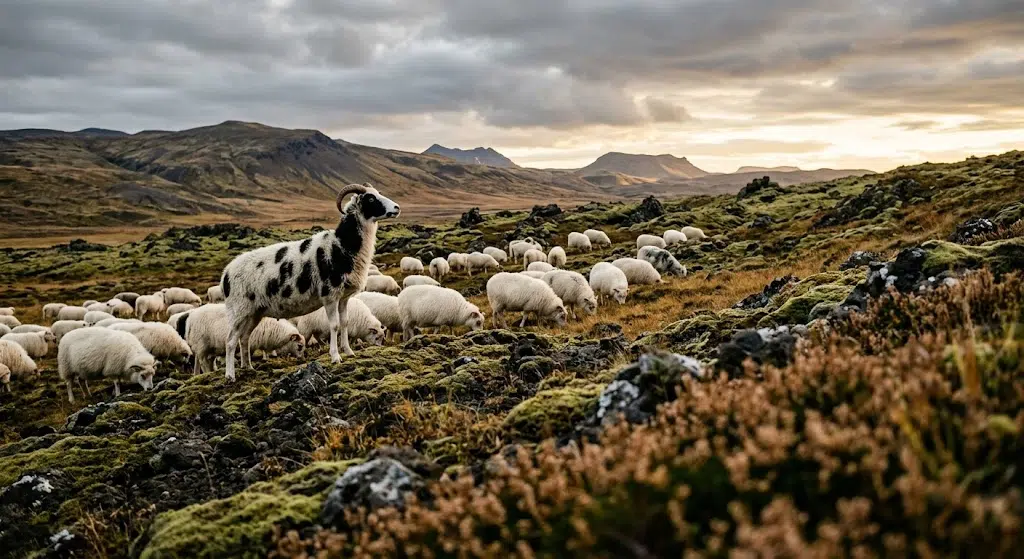
It has no other job. There is almost no muscle on it and hardly any fat, its lambs come in light, and the modern carcass grading system marks it down at every stage for being exactly what it is. Iceland bred an animal for a thousand years that its own meat grid cannot find a use for.
The law found a use for it. Jónsbók, the code adopted in 1281, lists the leader wether among metfé: stock valued as an individual rather than counted by the head, like a boat or a good horse. Bloodlines got famous. Farms bought and sold on reputation.
When a great one died, they kept the head.
Now the part that sounds like a story your grandfather made up, except that farmers wrote it down as a working fact for six centuries. They know the weather is coming. Sometimes most of a day out.
If your leader will not come out of the house on a morning that looks perfectly fine, you do not move the flock. That was the rule. Men who could not afford to be sentimental about anything arranged their winters around the opinion of a sheep.
Here is what that looked like on the ground.
The autumn round-up of 1884. A large flock has been gathered out of the interior, and ahead of it lies a full day’s crossing of the sands, which is a desert of black grit and rock with nothing on it to steer by even in good weather.
Snow was already falling when the men set out. It was bad enough that morning to argue about.
Inside an hour it was a blizzard. Every landmark went. There is no shelter out there and nothing to pitch a tent on, and turning back into it was worse than going forward.
At the head of the flock was a wether called Svartur, from Svínavatn, who already had a name.
So the fjallkóngur, the man in charge of the round-up and answerable for every man and every animal on it, made a decision that is either superstition or the coldest bit of professional judgement in the whole account. He gave the round-up to the sheep. He told his men one thing: stay together.
A third of the way over the sands, Svartur stopped. Then he turned and came back down the length of the flock, past hundreds of animals, to find the men at the rear.
They saw it straight away. His face had packed solid with ice and he could not see out of it.
They broke it off him. He went back up to the front and put his head into the weather again.
He came back for the same service several more times that night. Nobody ever went to fetch him. He knew where the men were, he knew what he needed, and he came and got it.
Then, hours later, he stopped and would not move at all. No amount of encouragement shifted him.
The men felt about in the dark and found grass under their boots. That told them they were off the sands. It told them nothing else whatsoever.
They sat it out. At first light the storm eased, the country came back, and they worked out where they were standing.
It was the exact spot where the round-up halts every single year once the sands are behind it. The same patch. He had been stopping there since he was a lamb, and he had walked to it through a night with no landmarks, no light and no visibility, with his eyes iced shut half the time.
New To Carnivore?
Get my Carnivore Guide, free.
The fjallkóngur told Svartur’s owner afterwards that without the animal, men would have died out there as well as sheep.
That story was one of hundreds. An old stockman called Ásgeir Jónsson frá Gottorp spent his later years going round the farms collecting them, and published the lot in 1953 as a book called simply Forystufé, three hundred pages of ordinary people describing what their sheep had done, going back to the 1840s.
He did not write it as folklore. He wrote it as an obituary. Winter grazing was ending, the disease culls were going through the flocks region by region, and Ásgeir believed he was recording something that would be gone inside a generation.
He nearly was right. The eradication programmes killed leader sheep along with everything else across most of the country, and the replacement stock came from districts that had none. Every leader sheep alive today traces back through that bottleneck to one corner of the north east. By 1976 it took an act of parliament, obliging the insemination stations to carry leader rams, to keep the thing breathing.
The talent, meanwhile, carried on doing what it does.
11 July 1994. Sigrún Helgadóttir set out with her husband and their three daughters to walk a seventeen-kilometre loop through the canyons at Jökulsárgljúfur. Sunshine, warm, a good day for it.
Across the river she noticed sheep. They were not grazing and they were not resting. They were striding north towards the farms with purpose, and she remembers thinking it was odd.
The family carried on south.
What came over the top of them a few hours later put down hail big enough to lie in drifts, separated one of the girls from the rest in the scrub, and dropped enough lightning that somebody in the party counted fifty strikes before giving up. It took out power lines and telephone lines across the whole district. Nobody up there could remember a storm like it.
The next day they called in at a farm called Vestara-Land, where they had bred leader sheep for decades, and told the woman of the house about their adventure.
She was not surprised in the slightest. Several hours before it hit, her leader sheep had brought a group of ordinary ewes down off the hill to the home gate and asked to be let in.
That account is on the museum’s own tales page, at forystusetur.is, written down by the woman who was out in it.

The rest is housekeeping. In 2007 somebody finally tested the leading itself: six sheep to a group, numbers tied to their flanks, driven out from the sheep house and back while two recorders wrote down the order they came past. Sixty runs. The leader came first in fifty-seven of them. Iceland recognised forystufé as a breed in its own right in 2017, on behaviour and genetics together, after the molecular work put them in a group of their own. In 2020 a controlled predator test ran in Applied Animal Behaviour Science: send a human, a dog and a drone through the pasture, and the groups with a leader in them settled back to grazing sooner and stood waiting at the exit while the dog was there. Bringing the flock home, measured with a clipboard.
There is a museum for them now, in an old village hall in the north east, run by the local schoolteacher, with the heads of the famous ones on the wall and a coffee named after the breed.
The saying they keep on the premises is that if you wear a jumper spun from their wool, you will always find your way home.
A thousand years of watching which animal was at the front when the light went. No laboratory, no software, no genome, just men in bad weather keeping records that turned out to be right.
We have replaced all of that with a grid that docks the same animal for not carrying enough fat, and we call ourselves the clever species.
Follow on Twitter (@SamaHoole) or Instagram (@samalifts).

